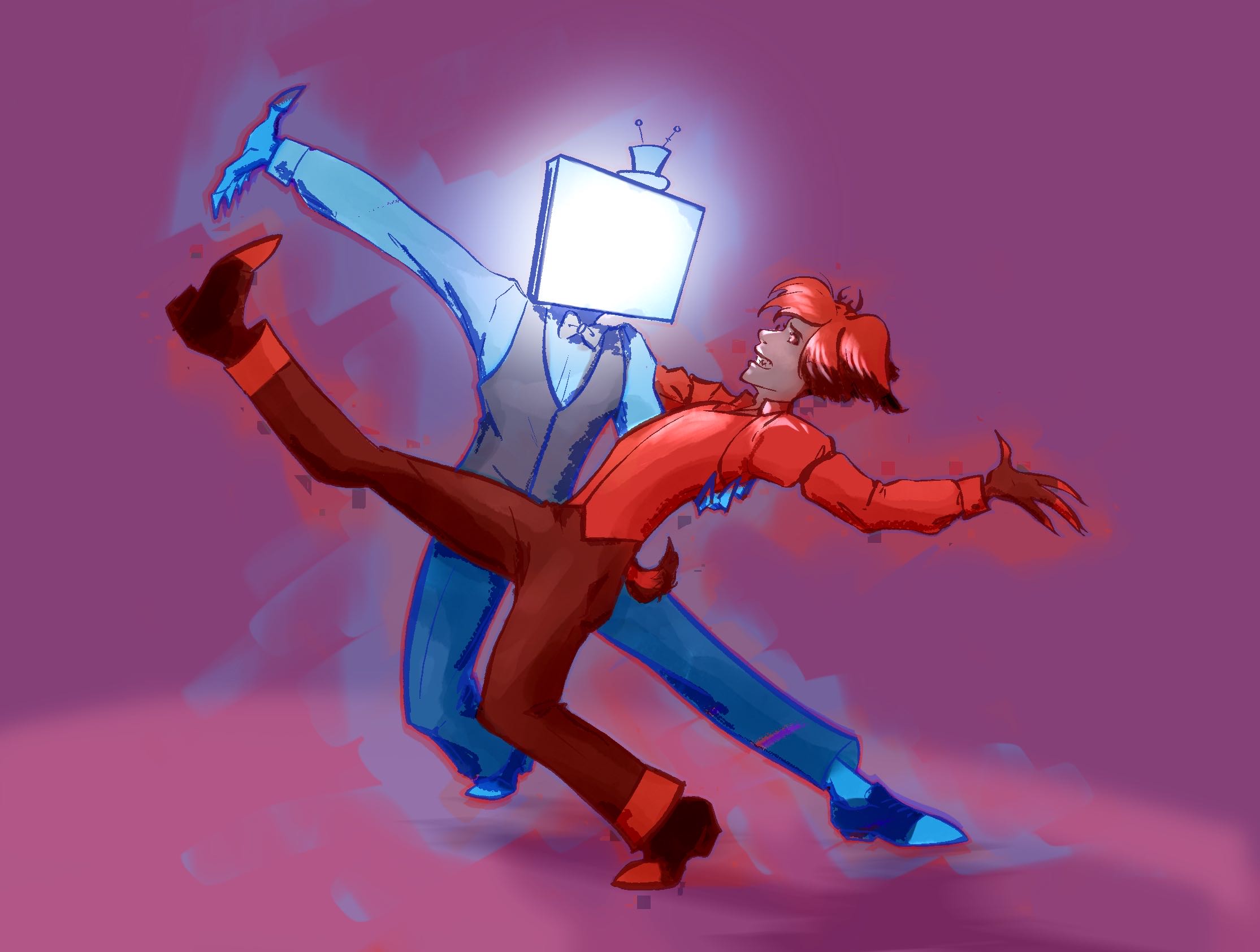
Thinking about
lose your marbles in act three
Hazbin Season 2 was off to a rocky start with the first two episodes but 3 and 4 brought it back to an insane, unexpected degree. Piss (A Love Song) might be the best song from the entire series and episode 4 is The Alastor Episode I've been awaiting since the beginning of the show. I had expected some backstory reveal given the setup of the prior episodes, but not the answer to the source of Alastor's power, a slice of his past conflict with Vox, AND his human backstory all in the same episode.
I can already declare from experience that episode 4 rewards rewatch, with surprising depth of detail to enjoy in Alastor and Vox's expressions, particularly.
The plot gave me a sense that I got more than I deserved or could've expected, somehow. It felt fanfiction-esque in its willingness to carry to a conclusion the relational dynamics that it set up, which made me realize that my expectation is for that *not* to happen? Almost the entirety of episode 4 had me thinking that I didn't expect such payoff for so little narrative time invested, and the finale's Alastor/Vox fight being so clearly a demonstration of Vox's emotional fragility and status anxiety, and the direct acknowledgment that his behavior was a ploy for attention from Alastor, was remarkably unsubtle. It shouldn't surprise me that a show with a bisexual main character in a lesbian relationship is willing to follow through on its suggestions of homoerotic obsession, but surprised I was! It's satisfying that the show spends a lot of time dwelling on the character's feelings and motivations, which is, I suppose, exactly what fanfiction has in common with musicals.
i *can* fix my own problems
Alastor and Vox both lie exactly on a line of plausible deniability about their own feelings with regard to their relationships. Does Vox love Val but he's vulnerable to being bullied out of acting like it with Alastor around, or does he use the other Vees? ("No more playin' house, once they're devout I won't need a squad") Does Alastor care about the hotel or does he have a complicated stupid plan that we can't see yet? ("What's in it for me? I don't work for free.")
I note that no one (*almost) has yet proven to Alastor that his "quid pro quo, it's only fair" strategy won't work, nor that any other strategy is possible to him. Attachment is suffering! It's psychologically difficult to owe people, and to ask for things, and even to give things when you don't trust that they'll be reciprocated in *some* way. Alastor, at the end of last season, nearly "died for his friends," yet drags his own broken body to the radio tower to heal alone, while Vox gets carried home in the arms of the allies he nearly destroyed. Suffering his angelic injury in the silence of his room is very reasonably considered a better strategy than going out to the lobby to get goaded by Lucifer, who won't even learn his name; and Rosie tells him no, she won't fix his staff despite her (later demonstrated) ability to do so, her warmth and geniality, and their apparent closeness. I don't think Alastor sees anything else as an option, despite having some close relationships. Addressing the *almost: Niffty would've dragged him off the battlefield, certainly? She does come to his aid as soon as she knows he's in a fight with the Vees, and drags Husk along. And it's the moment Niffty is under threat that prompts Alastor to offer Vox his deal; Alastor, altruist, captured for his only real friend. Or, he stops the fight at the last inflection point after which he would owe someone something, which is unacceptable -- "there are no friends in Hell."
Alastor strives for control in his relationships, for perfect autonomy and independence, which of course makes any intimacy somewhere between terrifying and untenable. The thing that upsets him most about his interaction with Rosie (as he helpfully growls the subtext) is "calling me her pet! I'll show her, oh she'll see!" The moment that finally triggers his quitting the hotel is not Lucifer's more pointed needling about uselessness which we (and Lucifer) expect to press Alastor's buttons about power, but the less targeted exhortation that he "should use a coaster." Alastor would rather give up entirely on the hotel and whatever that means to him than be told what to do. (Related: his earlier admission to Vaggi that he "enjoy[s] being difficult" rather than helping with Charlie, and Alastor's insistence on leaving his motivations mysterious.)
shine brighter
Obvious but fun symbolism in our (anti?)hero/villain setup this season, with Vox the friendly face, the light (Brighter), the team player, and Alastor the isolated dweller in shadows. Vox wants to be God, but Alastor wants to be the Devil, picking fights with Lucifer himself, clearly coveting his power. After the first season's inversion of Heaven as hegemonic villains and Hell as underdog heroes, this feels like a neat thematic round two.
There is also something to the video/radio split and Vox's obsession with eyes on him ("All the eyes look up at you," I'll show them what I'm meant to be"), while Alastor hides, melts into shadows, constantly disappears, disrupts cameras ("while he hid in radio"). Alastor wants ears, not eyes; being watched and being heard suggest different modes of attention. And he escapes from Vox's deal by wordplay, by depending on Vox not listening very carefully: "I didn't say not to hurt her, you moron. I *said* you're 'not to lay your hands on her.'" And Vox is constantly watching/spying, but also shown to be not really listening to anyone else, reading email while "talking" to Val, etc. I can't decide if this is a lazy reification of "screens = bad" or a nuanced take about the nature of attention but I like the thoroughness of the characterization.
you're broken from the start
Alastor has so much screentime but still has none of his own songs this season, remarkably. (The "I started this" "I'm singing it, I'll finish it" continues.) This reads as unwillingness to admit his own motivations even to himself/the camera, a neat encapsulation of his emotional guardedness. His walls are up so high he's not even cut out to be in a musical, and in fact complains to Rosie of the hotel's "crying and singing."
Vox, on the other hand, spends practically all of his time on screen revealing his motivations, with a classic "I want" song to incite his allies in "Once I Get Up There," some Harold Hill-esque salesmanship in "Bad With Us" and "Vox Populi"/"Vox Dei," an explication of his life and private wishes in "Brighter." Seemingly every possible expression of his desires is musicalized. I note that he is always in a mode of trying to convince or sell -- "imagine what it could enable," "you know you wanna be bad with us," "what could happen if we could run the ship" -- and this extends even to "Brighter," which he sings to himself alone in a room. The song is a self-help anthem (despite being unnervingly shot through with sociopathy): "you gotta climb a little higher," "it's not up to chance if you've got plans," "the world's yours, don't waste it." Vox speaks this way even to himself, so obsessed is he with his own image as a leader.
no victory will ever be enough
So, to see through Alastor's silence and Vox's torrent of words, what do they actually want? "Always knew the guy they're prayin' to was gonna be me", "bet our tower would look powerful with pearlier gates" -- Vox sees control and power as something reflected in other people's eyes, a path to approval and adoration. Alastor's only expressed wish is "once I figure out how to unclip my wings, guess who will be pulling all the strings" and "I want to continue my fun" -- he wants power and control as a means to freedom from reliance on others.
This is mostly a matter of intrinsic vs extrinsic motivation, and it's interesting that Alastor also seems to actually have a really strong aesthetic point of view, with his attachment to an actual literal radio show. Vox is the "Media Overlord" but it's not clear to me that he is even on TV all that often: "he is a reporter. I think," says Charlie, and VoxTek is a vast undefined megacorp with a biosciences division among other things. Vox seems to spend most of his time in V Tower upstairs in his own office making strategic decisions for the company (most scenes find him there rather than in a studio, and Katie Killjoy seems to treat his set visit as a special occasion). So it seems evident that he doesn't care all that much about television, at least not anymore, except as the best vehicle for getting him the attention he craves.
And this failure to attach to any pursuit beyond chasing attention ("flitting between this fad and that" per Alastor) has narrowed his imagination despite his clearly abundant motivational energy. "It's not what Heaven is, it's what it could be," he prompts the other Vees to imagine, but then fails to complete his own thought, except to gain power for its own sake, "a heavenly host that bows to none but us." "To everyone who doubted me: your doubting days are done" suggests that Vox only craves success to prove he can be successful, and Alastor's taunt that "no victory will ever be enough" seems pretty obviously in earnest.
Interestingly, the other Vees are not shown to be "broken from the start" in this way; Valentino and Velvette both actually show a capacity to imagine what they would do with their heavenly power ("hot new angel sluts" and "tear off their wings and make them dresses"), as vapid as those goals are. And both of them are often shown working on their specific artistic pursuits, Val in the studio and Velvette in the atelier. (Doubly interesting, imo, that the show doesn't make Val/Vel/Al better people than Vox, but instead suggests that it's still possible to have a healthier motivational structure while being a terrible person!)
So the show sets up a dichotomy between unfulfillable/attention-based/extrinsic motivation and fulfillable/craft-based/intrinsic motivation, with Vox and Alastor at each end of the spectrum. I expect next season (or, since apparently next season is about the Morningstars, maybe S4?) will examine the failure mode at the other end of the spectrum, and that Alastor's intense distaste for intimacy will fail him in the same way Vox's hunger for adoration prompted his fall in this season.